File 007 NUC // Nuclear & Radiation
Potassium Iodide for Radiation: What KI Pills Do and Don’t Do
Potassium iodide protects only the thyroid from radioactive iodine. See the FDA dose table by age, timing, who should skip it, and why salt and tincture fail.
Lab verdict
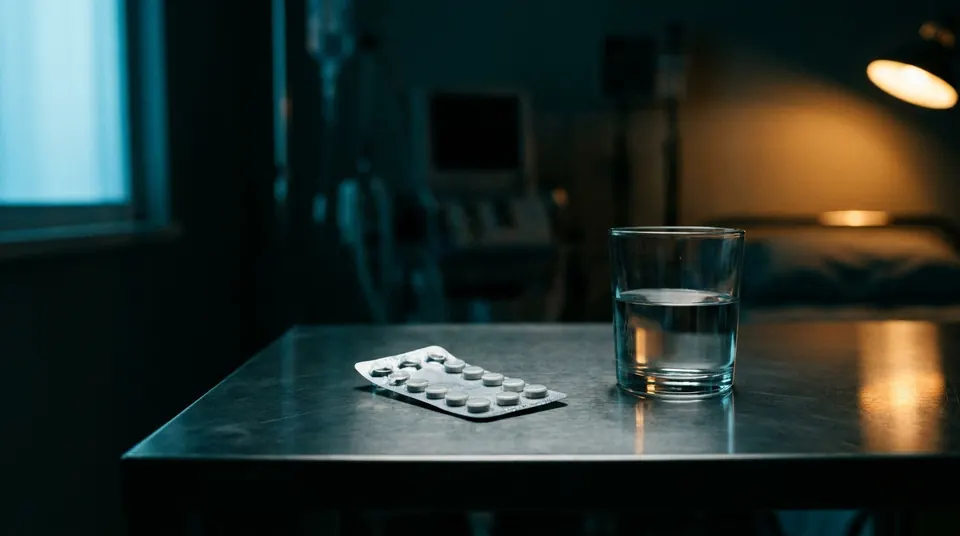
Potassium iodide (KI) for radiation blocks one thing: the thyroid taking up radioactive iodine. It does not shield you from external radiation or other isotopes. Take it only when public health or emergency officials tell you to, at the FDA dose for your age, ideally within 3-4 hours of exposure.
Key findings
- KI protects the thyroid gland from radioactive iodine and nothing else. It is not a general radiation protectant.
- FDA adult dose is 130 mg; children and infants get less, by age band (table below).
- Take it only when public health or emergency officials tell you to. Extra doses add risk, not protection.
- Iodized salt, iodine tincture and Betadine are not substitutes.
- In a nuclear attack, shelter comes first. KI is a supplement.
MythIodine pills protect you from nuclear radiation.
EvidenceFDA: KI works only to prevent uptake of radioactive iodine into the thyroid. It is not a general radioprotective agent.
MythIodized salt or iodine antiseptic will do the same job.
EvidenceA single 130 mg KI tablet equals roughly 3.5 pounds of iodized salt, by one industry figure reported by NPR. Antiseptics are not made to be swallowed.
Potassium iodide for radiation is one of the most misunderstood items in prepper kits. People buy it as if it were a force field. It is closer to a single, narrow lock on a single door.
The door is your thyroid. The pill does nothing for your bone marrow, lungs, gut or skin. This article covers what KI does, the exact FDA doses, when it is and is not worth taking, and which popular substitutes are dangerous.
Safety: Take potassium iodide only when public health or emergency officials tell you to. Do not take it “just in case” and do not take more than the labelled dose. This page repeats official guidance and is not medical advice.
What potassium iodide does for radiation exposure
Your thyroid pulls iodine out of the blood because it needs it to make hormones. It cannot tell stable iodine from radioactive iodine. Reactor accidents and nuclear detonations release radioactive iodine (iodine-131), and a thyroid that absorbs it takes a radiation dose from the inside.
KI floods the system with stable iodine. The thyroid fills up, and the radioactive iodine that arrives afterwards mostly passes through. FDA puts the limit plainly: KI “works only to prevent the uptake of radioactive iodine into the thyroid gland” and “is not a general radioprotective agent.”
So KI does not help with:
- Gamma radiation from fallout on the ground or roof. That is the main danger right after a detonation, and distance and shielding handle it (see how to shelter).
- Other radioactive isotopes such as cesium-137 or strontium-90.
- Radiation from a dirty bomb, which FDA names as an example of something KI does not cover.
- Radioactive iodine that has already been absorbed. Timing matters.
State health departments frame KI the same way: a supplement to sheltering or evacuation, not a replacement (New York State Department of Health).
FDA dose table by age
These are the doses FDA publishes for thyroid blocking. The “threshold” column is the predicted thyroid radiation dose at which officials would advise taking KI for that group. You cannot measure that number yourself. That is one reason the instruction has to come from officials.
| Group | Predicted thyroid exposure (cGy) | KI dose | 130 mg tablet | 65 mg tablet | 65 mg/mL solution |
|---|---|---|---|---|---|
| Adults over 40 | over 500 | 130 mg | 1 | 2 | 2 mL |
| Adults 18 to 40 | over 10 | 130 mg | 1 | 2 | 2 mL |
| Pregnant or lactating women | over 5 | 130 mg | 1 | 2 | 2 mL |
| Adolescents 12 to 18 | over 5 | 65 mg | 1/2 | 1 | 1 mL |
| Children over 3 to 12 years | over 5 | 65 mg | 1/2 | 1 | 1 mL |
| Children over 1 month to 3 years | over 5 | 32 mg | solution only | 1/2 | 0.5 mL |
| Infants, birth to 1 month | over 5 | 16 mg | solution only | solution only | 0.25 mL |
Source: FDA, Frequently Asked Questions on Potassium Iodide.
Two notes from the same page. Adolescents above about 150 lb (70 kg) take the full adult dose of 130 mg. And the liquid comes with a dropper marked at 1, 0.5 and 0.25 mL, with 65 mg in each mL.

Timing and duration
FDA says KI works best if used within 3-4 hours of exposure. The same page says local public health or emergency management officials will tell people if KI is needed, and that you should follow their instructions. It also says KI should not be taken as a preventative before radiation exposure.
Once it is taken, the protection is short. FDA says KI protects for about 24 hours, so it is dosed daily until the risk is over. Pregnant women and newborns are the exception: FDA does not recommend repeat dosing for them unless other protective measures are unavailable.
More is not better. FDA warns that a higher dose, or dosing more often than recommended, does not give more protection and can cause severe illness or death.
Who benefits most, and who should be careful
Young thyroids are the priority. FDA ranks the highest priority as infants, children, and pregnant or nursing women. Adults over 40 get the lowest priority, with a threshold 100 times higher than the pregnant-women threshold in the table (over 500 cGy versus over 5). FDA’s reason: they should take it only if exposure is high enough to destroy the thyroid and cause lifelong hypothyroidism.
FDA says to avoid KI if you:
- Have a known iodine sensitivity.
- Have dermatitis herpetiformis or hypocomplementemic vasculitis.
- Have a nodular thyroid with heart disease.
Use caution with multinodular goiter, Graves’ disease or autoimmune thyroiditis, especially if dosing runs beyond a few days. A shellfish or seafood allergy does not necessarily mean iodine allergy, per FDA.
Side effects are unlikely at the recommended dose over a short time. The ones FDA lists: rashes, swollen salivary glands, and “iodism” (metallic taste, burning mouth and throat, sore teeth and gums, sometimes upset stomach or diarrhea). Facial or throat swelling, fever, joint pain or trouble breathing is an allergic reaction. Severe shortness of breath needs immediate medical attention.
Does KI matter in a nuclear attack?
Less than people think. After a detonation, the first-hours hazard is external gamma radiation from fallout particles. Getting indoors, ideally into the middle of a large building or a basement, cuts that dose. Ready.gov’s guidance is “get inside, stay inside, stay tuned”, with sheltering usually lasting at least 24 hours. KI adds nothing to that.
Where KI earns its place is thyroid exposure from radioactive iodine. WHO describes stable iodine by mouth, together with control of food and drinking water, as a suitable way to lower that risk, and many countries build it into emergency plans (WHO 2017 guidelines). In an attack, officials with measurements might advise it for certain areas and groups. The timeline of what fallout does after the first day is covered in how long fallout lasts, and the choice of room in apartment sheltering.
The practical point: a family that owns KI and skips sheltering has the priorities reversed. Buying a bottle can feel like preparation. Choosing a room, stocking water and knowing which radio station to tune to are the parts that change outcomes in the first day.
What to buy, and shelf life
FDA lists these as approved over-the-counter products (as of its March 2022 page):
- iOSAT 130 mg tablets and 65 mg tablets (Anbex)
- ThyroSafe 65 mg tablets (BTG International)
- Potassium Iodide Oral Solution USP, 65 mg/mL (Mission Pharmacal)
Check the expiry date printed on your package. FDA has published guidance on extending the shelf life of stockpiled KI tablets, but that process is aimed at federal, state and local government stockpiles, not home bottles (FDA guidance). Home buyers should treat the date on the label as the limit.
Salt, tincture and other substitutes
Myth: “Table salt, kelp or iodine antiseptic works the same as a KI tablet.”
Iodized salt contains enough iodine for ordinary nutrition. It does not contain enough to block radioactive iodine. NPR reported the Salt Institute’s estimate that you would need about 3.5 pounds of iodized salt to equal the 130 mg of iodine in one KI tablet (NPR). That is a trade group’s figure, but the direction is not in doubt, and the salt load itself would be harmful.
Iodine tincture and povidone-iodine (Betadine) are skin antiseptics. They are not made, dosed or tested for swallowing. A povidone-iodine product label warns that swallowing large quantities can raise blood iodine and cause thyroid problems, including goitre, hypothyroidism and hyperthyroidism (HPRA product information). A pharmacy faculty bulletin from Mahidol University also calls the skin-absorption route unpredictable (Mahidol University). No official guidance we found recommends either one for thyroid blocking.
Kelp and iodine supplements fall in the same bucket: wrong dose, no testing for this purpose.
Lab verdict
- KI protects one organ from one isotope family. Treat it as a minor add-on to a shelter plan.
- Buy an FDA-approved product only if you want one, check the expiry, and write the age-based dose from the table on the box lid.
- Do not take it until officials say so. If you are over 40 and not pregnant, you are the lowest priority and may be told you do not need it.
- If you or a family member has a thyroid condition or an iodine allergy, ask a doctor now, not during an emergency.
- Spend the effort that would go into extra bottles on getting a good room and 24 hours of supplies instead.
Frequently asked questions
Does potassium iodide protect against radiation?
Only one kind. It stops the thyroid from absorbing radioactive iodine. FDA says it is not a general radioprotective agent, so it does nothing against external gamma rays, other isotopes or a dirty bomb. Shelter and distance remain the main protection after a nuclear detonation.
When should you take potassium iodide?
When public health or emergency officials tell you to. FDA says KI works best within 3-4 hours of exposure and protects for about 24 hours, so it is repeated daily until the risk ends. FDA also says KI should not be taken as a preventative before exposure, and extra doses can cause severe illness.
What is the potassium iodide dose for adults and children?
FDA lists 130 mg for adults and pregnant or lactating women, 65 mg for children over 3 and adolescents (adolescents over about 150 lb take 130 mg), 32 mg for children over 1 month to 3 years, and 16 mg for newborns. See the table above for tablet counts.
Can I use iodized salt or Betadine instead of KI tablets?
No. Iodized salt has far too little iodine per serving to block radioactive iodine, and the amount needed would be harmful. Betadine and tincture are skin antiseptics. Swallowing them risks thyroid problems and poisoning. No official guidance recommends them for this purpose.
Should people over 40 take potassium iodide?
Usually not unless exposure is very high. FDA gives adults over 40 the lowest priority: they should take KI only if exposure is high enough to destroy the thyroid and cause lifelong hypothyroidism (over 500 cGy predicted). Officials will say who qualifies.
Sources
- FDA: Frequently Asked Questions on Potassium Iodide (KI)
- FDA: Potassium Iodide Tablets Shelf Life Extension guidance
- Ready.gov: Nuclear Explosion
- New York State Department of Health: KI fact sheet
- NPR: Iodized salt is no antidote for radiation
- HPRA: povidone-iodine product information
- Mahidol University Faculty of Pharmacy bulletin on Betadine and radiation
- WHO: Iodine thyroid blocking guidelines (2017)
General information, not medical or professional advice. In a real emergency, follow instructions from officials and call 911. Disclaimer.