File 009 MED // Emergency Medicine
How to Apply a Tourniquet: Steps, Mistakes and What the Data Says
Life-threatening arm or leg bleeding needs a tourniquet 2-3 inches above the wound. Stop the Bleed steps, common mistakes, and what the military data shows.
Lab verdict
For life-threatening bleeding from an arm or leg, call 911, then put a tourniquet 2-3 inches above the wound, never over a joint. Tighten until the bleeding stops, secure it, note the time, and do not loosen or remove it. If one is not enough, add a second above the first.
Key findings
- Use a tourniquet when pressure fails or the bleeding is life-threatening: spurting, pooling or soaking through. Call 911 first.
- Place it 2-3 inches above the wound, between the wound and the heart, not on a joint. Tighten until bleeding stops, then secure it and note the time.
- Military data show tourniquets save lives. In one Baghdad study, no amputations resulted solely from tourniquet use.
- Commercial devices with a windlass beat improvised ones in small tests. Buy one, then take a Stop the Bleed class.
MythA tourniquet will make you lose the limb.
EvidenceIn a Baghdad combat hospital study of 232 patients who needed tourniquets, no amputations resulted solely from tourniquet use. Temporary nerve palsy occurred in 1.7%.
MythA belt or a strip of cloth works as well as a real tourniquet.
EvidenceIn a small military test, a commercial CAT worked in every trial while improvised bandage and bandana tourniquets worked 40% and 10% of the time. A windlass and a wide strap matter.
If an arm or leg is bleeding hard enough to spurt, pool on the ground or soak through a dressing, you need to know how to apply a tourniquet. Direct pressure comes first, but when pressure cannot hold, a tourniquet is the tool that stops the bleeding.
The steps below follow Stop the Bleed, the American College of Surgeons program, and the American Red Cross guidance. Read them once now. Nobody reads an article while a person is bleeding.
When you need a tourniquet
A tourniquet is for life-threatening bleeding from an arm or a leg. Most cuts are not that. A scrape, a shallow gash or a slow ooze stops with a clean cloth and firm pressure.
Use a tourniquet when:
- Blood is spurting or pulsing from the wound.
- Blood is pooling on the ground or soaking through clothes.
- Direct pressure with a dressing does not control the bleeding.
- The limb is mangled or amputated and you cannot see where the blood is coming from.
It does not work on the neck, chest, belly or groin, because there is no way to squeeze those areas against bone. Those wounds need packing and pressure. We cover that below. For a shooting, our gunshot wound first aid guide puts the whole sequence in order.
How to apply a tourniquet: step by step
- Call 911, or tell someone to call. If you are alone, call on speaker and put the phone down. A tourniquet buys time. It does not replace a hospital.
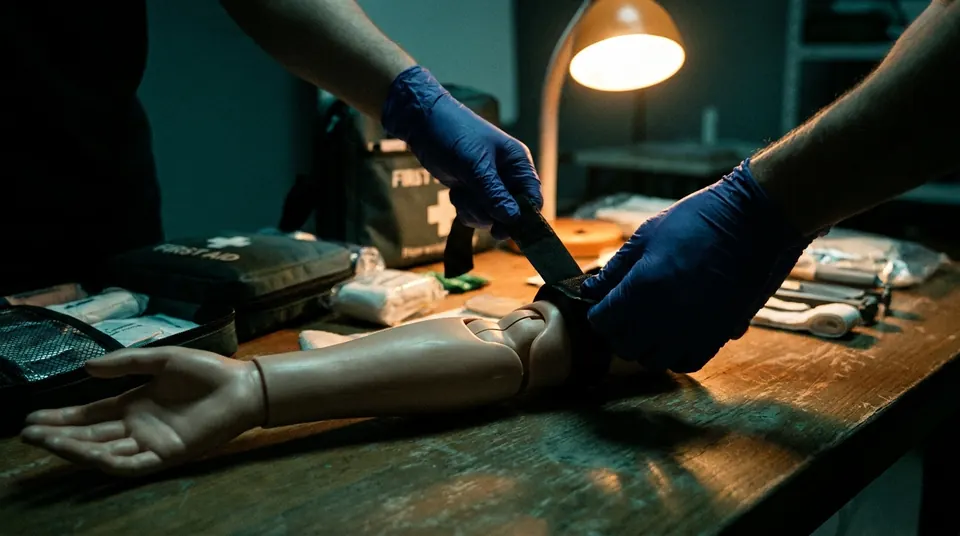
- Get the tourniquet on the limb, above the wound. It can go over clothing. Place it 2-3 inches above the wound, between the wound and the heart. Do not put it on the wound or on a joint. If the wound sits at a knee or elbow, go above the joint.
- Pull the strap tight and fasten it. On a typical windlass device, you pull the free end through the buckle and cinch the strap as tight as you can before the next step.
- Twist the windlass rod until the bleeding stops. Keep twisting until the blood flow stops or is significantly reduced.
- Lock the rod. Secure it in the clip so it cannot unwind.
- Note the time. Write it on the device, on the person’s skin, or tell the crew when they arrive. Responders need the clock.
- Do not loosen or remove it. It stays on until medical personnel take over.
- If bleeding continues, add a second tourniquet above the first. Put it next to the first one, closer to the heart.
- Stay with the person until help arrives.
Brands differ in the buckle and rod design, but the logic does not change: tight, locked, timed, left alone.
Safety: Stopping the blood flow is the point. Official guidance says do not loosen or remove the tourniquet, even if it looks like the bleeding has slowed.
Why it works
Arm and leg arteries carry blood under pressure. A tourniquet is a wide band that you tighten until it compresses the vessels against the bone, and the flow beyond the band stops. Direct pressure does the same thing at the wound itself, but it needs a steady hand and a free pair of hands for a long time. A tourniquet does it without you.
That is why placement matters. Over a joint, bone and tendon get in the way and the band cannot close the vessels properly. Too close to the wound and you end up in the damaged tissue.
Wounds where a tourniquet will not fit
Some places have no limb to wrap: the armpit, the groin, the neck and the base of a limb. These are often called junctional wounds. Stop the Bleed teaches pressure and packing for them, and the guidance from the program’s community partners reads the same way:
- Press firmly on the wound with both hands using a clean cloth, dressing or gloved hand.
- For a deep wound, pack it with gauze or clean cloth, then keep firm pressure on it.
- If the dressing soaks through, add more on top. Do not remove the saturated one.
Training on this beats reading about it. We could not verify a precise pressing time from an official source, so we give none. Keep pressure on until help takes over.
Commercial tourniquet or improvised one
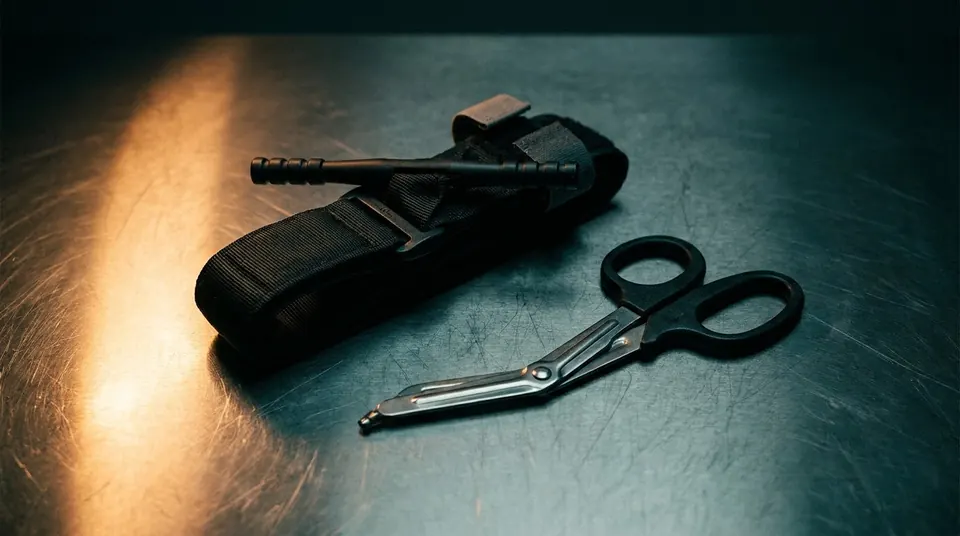
Carry a real one. The device the military and Stop the Bleed trainers use has a wide strap, a way to tighten it and a way to lock it. The Committee on Tactical Combat Casualty Care (CoTCCC) maintains a list of recommended devices. A 2019 update published in the Journal of Special Operations Medicine lists the CAT (Gen 6 and 7), the SOFTT-W, the TMT, the RMT-T/TX2/TX3 and the SAM-XT among the non-pneumatic models. CoTCCC advice is written for combat medics, so treat the list as a guide to well-tested products, not a guarantee for every user.
Improvised tourniquets fail more often. One small military test reported in the Journal of Special Operations Medicine had two users do 10 trials per device. The commercial CAT was effective every time. An improvised bandage tourniquet worked 40% of the time and a bandana 10%. That is a tiny sample, so do not quote the percentages as a law. The direction is clear, though: a strip of cloth without a windlass is hard to tighten enough.
Does that mean an improvised one is useless? We found no official source that endorses a specific home-made design, so we do not describe one. If you have nothing else, direct pressure and packing remain the first line. And the fix is cheap: put a real tourniquet in your car, bug out bag and home kit. Our survival gear list puts it near the top for that reason.
What the data says about limb loss
The most common objection is that a tourniquet costs you the limb. The best evidence we found points the other way.
Kragh and colleagues followed patients at a US combat support hospital in Baghdad for seven months in 2006. Of 2,838 admitted patients with major limb trauma, 232 needed tourniquets. Clinicians applied 428 tourniquets to 309 limbs. In the Annals of Surgery study, 31 patients (13%) died. The authors reported that “no amputations resulted solely from tourniquet use.” Temporary nerve palsy at the tourniquet level occurred in four patients (1.7%).
On survival, the same study found that tourniquets applied before reaching the hospital went with lower mortality (11%) than those first applied in the emergency department (24%). Five casualties who needed a tourniquet but did not get one had 0% survival, against 87% for those who did. Five is a very small group, and this was an observational study, not a randomized trial. You cannot randomize people to bleeding. Still, the authors concluded that tourniquet use when shock was absent was strongly associated with saved lives.
A related paper by Kragh and others in the Journal of Trauma reviewed practical use of emergency tourniquets. According to secondary summaries of its abstract, total tourniquet time showed no apparent association with complications. We could not read the full text, and there is no proven safe time limit, so do not treat any number of hours as a license to leave one on. Get the person to a hospital.
The conclusion for a lay rescuer is simple. The risk from the band is small and mostly temporary. The risk from uncontrolled bleeding is death.
Myth: “Tourniquets are a last resort because they cost limbs.” In the Baghdad data, no amputations came from the tourniquet itself. The limbs lost were lost to the injury.
Mistakes that get people killed
- Waiting too long. If direct pressure is failing, move to the tourniquet. Do not spend minutes hoping.
- Putting it on a joint. It will not hold.
- Too loose. If blood still flows, it is not tight enough. Add a second one above the first.
- Forgetting to note the time. The hospital needs it.
- Removing it. Leave that to medical staff.
- Practicing for the first time in an emergency. Fumbling a buckle in the dark is common. Practice on your own thigh with the device you own.
Get trained, and keep a kit
Stop the Bleed runs courses with trained instructors, and you can find them through stopthebleed.org. The program covers three actions for severe bleeding: applying pressure, packing a wound and applying a tourniquet. Hands-on practice with a trainer beats any article, ours included. For what goes in the pouch itself, see trauma kit versus first aid kit.
This also matters for planning. When emergency services are overloaded, such as in a long grid-down event, response times stretch. The person next to the victim becomes the first responder. The same logic applies to infections. A tourniquet stops one kind of death, but a dirty wound without medical help risks another, and we explain why fish antibiotics are not the answer there.
Lab verdict
- Pressure first. If it fails or the bleeding is life-threatening, tourniquet.
- 2-3 inches above the wound, not on a joint, tight until the bleeding stops, locked, timed, left on.
- The limb-loss fear is not supported by the military data we found.
- Buy a commercial device. Improvised ones fail more often in the tests we found.
- Take a class. Practice once on yourself.
Frequently asked questions
Where do you put a tourniquet?
Place it 2-3 inches above the wound, on the side toward the heart. Avoid the wound itself and avoid joints such as the knee or elbow. If the wound is at or just below a joint, put the tourniquet above the joint. It can go over clothing if you do not have time to cut it away.
How tight should a tourniquet be?
Tight enough to stop the bleeding or reduce it significantly. For a windlass device that means cinching the strap, then twisting the rod until blood flow stops, and locking it in the clip. If blood still comes through, apply a second tourniquet above the first.
How long can you leave a tourniquet on?
Leave it on until medical personnel take over. Do not loosen it or remove it yourself. Write down the time you applied it so responders know how long it has been on. We found no official source that sets a safe duration for lay rescuers, so get the person to hospital care fast.
Can I use a belt as a tourniquet?
Belts and cloth strips often cannot be tightened enough. In one small military test, improvised bandage and bandana tourniquets were effective 40% and 10% of the time, while a commercial CAT worked every time. Commercial devices are strongly preferred. If you have nothing, direct pressure and packing remain the standard first steps.
Do tourniquets cause amputation?
The military data we found say no. A Baghdad combat hospital study of 232 patients who needed tourniquets reported that no amputations resulted solely from tourniquet use. Temporary nerve palsy occurred in 1.7%. The bigger danger is not using one when bleeding is life-threatening.
Sources
- Stop the Bleed, American College of Surgeons
- American Red Cross: How to Apply a Tourniquet
- Georgia Southern University Public Safety: Stop the Bleed steps
- Kragh et al., Survival with emergency tourniquet use to stop bleeding in major limb trauma, Annals of Surgery 2009
- Kragh et al., Practical use of emergency tourniquets to stop bleeding in major limb trauma, Journal of Trauma 2008
- CoTCCC tourniquet recommendations update, Journal of Special Operations Medicine, 2019
- Journal of Special Operations Medicine, Winter 2015: CAT versus improvised tourniquets
General information, not medical or professional advice. In a real emergency, follow instructions from officials and call 911. Disclaimer.