File 015 GER // Gear Lab
Survival Gear List: The 12 Items That Actually Matter
A survival gear list built from official kit guidance and real scenarios: 12 items that earn their weight, what to look for, and the gear we would skip.
Lab verdict
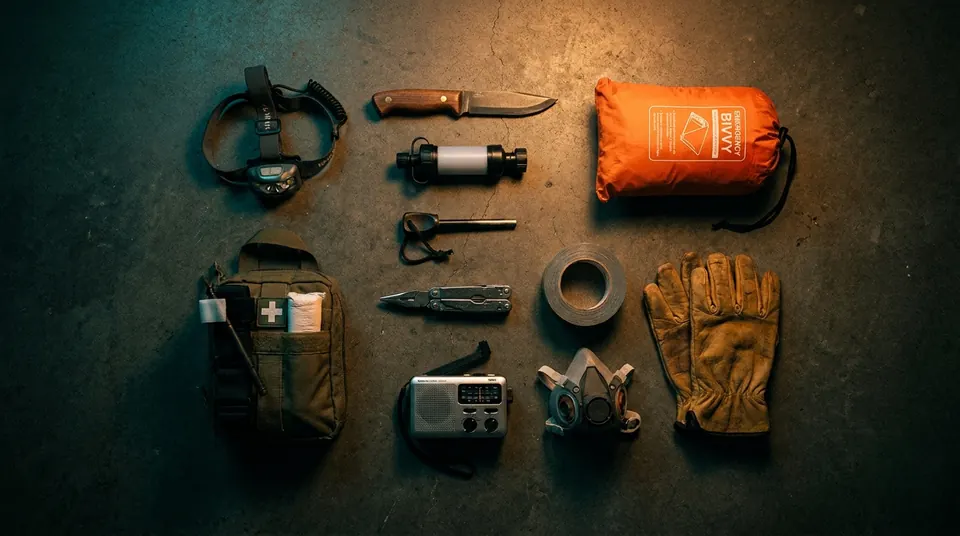
A useful survival gear list covers breathing, bleeding, warmth, water, light, communication and power. The 12 core items are a water filter, headlamp, knife, multi-tool, fire kit, bivvy, first-aid kit with tourniquet, battery bank, NOAA radio, tape and cord, gloves, respirator.
Key findings
- Ready.gov’s basic kit is the baseline: water, food, radio, light, batteries, first aid, whistle, dust mask, tape, tools, maps, phone charger.
- Pick gear by scenario: house without power, stranded car, evacuation, lost outdoors.
- Gear without practice fails. A tourniquet you have never applied is a guess.
- Skip cheap 100-in-1 kits, gimmick tools and anything you cannot test.
- Skills and a plan beat any item on this list.
MythMore gear means better odds.
EvidenceWeight, cost and complexity cut against you. A few reliable items you have practiced with beat a pile of untested ones.
MythA filter makes any water safe.
EvidenceCDC says most portable filters will not remove viruses. Only nanofiltration and reverse osmosis types do. Boiling is the reliable fallback.
A good survival gear list is short. Most of what sells as “survival gear” fails in a simple way: it solves a problem you will not have, or it solves a real problem badly. This list works backwards from the scenarios people actually face, and from official kit guidance rather than product reviews.
We did not field-test these items and we are not selling any of them. What follows is a judgment built on Ready.gov, CDC, NIOSH-related studies and Stop the Bleed material, with our reasoning shown so you can disagree with it.
How we chose: scenarios first
Four situations cover most realistic emergencies:
- Home without power or water for days (storm, grid failure). See what happens if the grid goes down.
- Stranded vehicle in winter or in remote country.
- Evacuation on short notice, with a bag you can carry.
- Lost or injured outdoors for a night or two.
Priorities run in the order the body fails: airway and severe bleeding first, then heat loss, then water, then food. Gear that does not serve one of those is optional.
Ready.gov’s baseline kit sets the floor. It lists water at one gallon per person per day, non-perishable food, a battery or hand-crank radio plus a NOAA Weather Radio, flashlight, extra batteries, first aid kit, whistle, dust mask, plastic sheeting and duct tape, sanitation items, a wrench or pliers, a manual can opener, local maps and a phone with chargers and a backup battery. The 12 items below are a sharper, more personal layer on top of that.
The survival gear list: 12 items
| # | Item | Scenario it saves you in | What to look for | Skip if |
|---|---|---|---|---|
| 1 | Water filter plus a way to boil | Home without water; outdoors | Absolute 1 micron or smaller, NSF/ANSI 53 or 58 cyst rating | You only carry a straw filter and nothing else |
| 2 | Headlamp | Any night emergency | Hands-free, spare batteries of the same type | You carry only a phone light |
| 3 | Fixed-blade or sturdy folding knife | Cutting cord, food, kindling | Full-length steel, a grip you can hold wet | It is a novelty blade with a hollow handle |
| 4 | Multi-tool | Home repairs, vehicle, utilities | Pliers that grip, locking blades | It is a thin gift-set tool |
| 5 | Fire kit (lighter plus ferro rod) | Warmth, boiling water | Two lighters, kept dry | You never practiced |
| 6 | Emergency bivvy and insulation | Stranded car, lost outdoors | Bag shape, not a flat foil sheet | You have a real sleeping bag in the car |
| 7 | First-aid kit with tourniquet | Any injury | Commercial tourniquet, pressure bandage, gloves | You have not taken a course |
| 8 | Battery bank | Phone and radio power | Enough for several full phone charges, kept charged | The cells are old and swollen |
| 9 | NOAA weather radio | Power and cell outage | All Hazards, battery backup | You will not set it up |
| 10 | Duct tape and cordage | Repairs, shelter, sealing | Flat roll, not a mini roll | You have no vehicle or home to repair |
| 11 | Work gloves | Debris, cold, chores | Leather or reinforced palm | Thin garden gloves are all you have |
| 12 | N95 or P100 respirator | Smoke, dust, debris | NIOSH-approved, fits your face | You cannot get a seal |
Now the reasoning behind the ones that need it.
Water: filter and boil, not filter alone
Water is where many kits fail by omission. A filter is one tool, not a guarantee.
CDC’s filter guide says to look for a filter with a pore size of 1 micron or less, and that absolute ratings are better than nominal ones, because a nominal filter is only an average and larger pores let some particles through. It also names NSF/ANSI standards 53 or 58 for cyst reduction (CDC: A Guide to Water Filters). The catch is viruses: CDC says nanofiltration and reverse osmosis filters remove them, which means most backpacking filters do not.
So pair the filter with a way to boil. CDC’s backcountry guidance has a rolling boil of one minute as highly effective, extended to three minutes above about 6,500 feet (2,000 m) (CDC: backcountry water treatment). A small metal pot costs little and does what a filter cannot.
Light, fire and warmth
A headlamp frees both hands. Spare batteries of the same type matter more than extra brightness.
For fire, carry two lighters and a ferro rod as the backup. Fire’s job is warmth and boiling water. In cold, it is not the first answer: shelter and insulation come before building a fire, and burning fuel in an enclosed space brings carbon monoxide risk. The physics of why is in how long you can survive in the cold.
Safety: Never run a generator, charcoal grill or camp stove indoors. CDC says generators go outdoors more than 20 feet from windows, doors and vents, and that you should keep battery-powered or battery backup CO alarms near every sleeping area (CDC). For heater rules, read can you use a propane heater indoors.
An emergency bivvy beats a loose foil blanket for one reason: a bag keeps wind and your own warm air close, while a sheet slips, tears and flaps. This is our reasoning, not a tested comparison. For a stranded car, a real sleeping bag or wool blanket stored in the trunk beats both.
Bleeding: the one place gear is a medical device
Ready.gov’s basic list names a first aid kit but not a tourniquet, so add one yourself. Stop the Bleed, run by the American College of Surgeons, notes that bleeding is the number one cause of preventable death after injury and teaches anyone to control it with three actions.
A commercial tourniquet is the one item here you should not improvise. Belts and shirts tend to fail because they cannot be tightened enough. Learn how in how to apply a tourniquet and take a Stop the Bleed course. Gloves and a pressure bandage round out the kit. Our trauma kit versus first aid kit guide lists what else belongs in the pouch, including gauze for wound packing.
Note: We do not list antibiotics or prescription drugs in the kit. Those belong in a conversation with your doctor.
Tools, tape and gloves: boring, and used most
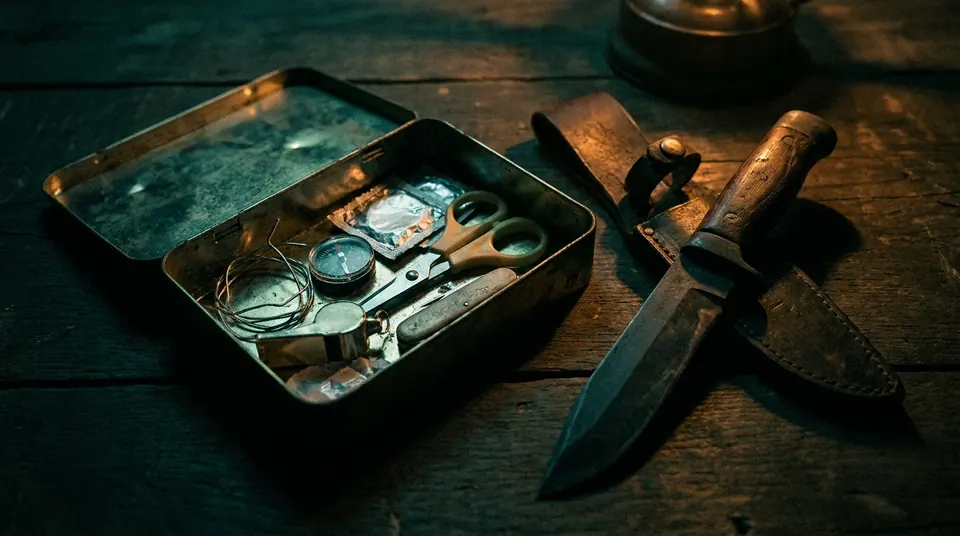
The knife, multi-tool, duct tape, cord and gloves are the least exciting items on the list and the ones you will use most. In a power outage they do the unglamorous jobs: cutting open packaging, shutting off a utility valve (Ready.gov lists a wrench or pliers for exactly that), taping a broken window, tying a tarp, moving debris without shredding your hands.
For the knife, we favor a simple full-tang fixed blade or a sturdy locking folder over anything marketed with the word “tactical”. For the multi-tool, test the pliers. If they flex or do not grip, the tool is a toy. Gloves belong in every kit because hands are your most-used tool, and an injured hand ends most other plans.
None of this needs a big budget. It needs you to have used each item once, so the first time is not during an emergency.
Communication and power
A NOAA Weather Radio broadcasts 24 hours a day on seven VHF frequencies from 162.400 to 162.550 MHz through more than 1,000 transmitters, and carries all-hazard alerts beyond weather (NWS: NOAA Weather Radio). It needs a special receiver, so a regular AM/FM radio will not pick it up. Buy one with a battery option, test it, and set your county code.
A battery bank keeps the radio and phone alive. Ready.gov lists a phone with chargers and a backup battery in its kit (Ready.gov). Charge it every few months, because batteries lose charge in storage, and top it up when a G4 or G5 solar storm watch is issued. A spare radio can sit in a shielded container if you want cover against the unlikely case of an EMP.
Respirator: pick the filter class on purpose
Smoke, dust and debris are common in storms, fires and building collapses. A dust mask is on Ready.gov’s list, but a NIOSH-approved respirator filters far better. N95 filters at least 95% of particles, and a “100” class such as P100 filters 99.97%, in NIOSH testing (CDC / NIOSH study of N95 and P100 filters).
Fit matters as much as the rating. A respirator that does not seal to your face lets particles leak around the edges. If you have a beard, a tight seal may be impossible, and you should pick another option. For radioactive dust, see whether you need a gas mask for nuclear fallout.
Gear we would skip
Myth: “A 100-in-1 survival kit has everything.”
- Cheap multi-piece kits. Many have flimsy tools, weak whistles, and fishing hooks you will never use. Build your own from the table.
- Paracord bracelets as primary cordage. A few feet of cord on your wrist is not a plan. Carry a real hank in your bag.
- Gimmick tools. If a tool combines eight functions and does each badly, take the single-purpose version.
- Anything untested. A stove, filter or radio you have never used is a hope, not a tool.
- A boat bought as a bug-out plan. It is the biggest gear purchase of all, and it brings fuel, upkeep and storm risk. We weigh it in is a boat a good bug-out shelter.
We have not lab-tested any of these categories. The advice follows from how the failures work, and you can verify each by trying the item before you need it.
How to build the kit
- Start with the Ready.gov list for your household and add water.
- Add the 12 items in the order the table gives them.
- Put a small version in each vehicle and a carry-ready bug out bag near the door.
- Test everything once: boil water, run the radio, light a fire, apply a practice tourniquet.
- Rotate batteries and food on a calendar.
Lab verdict
- Spend first on water treatment, a real tourniquet, warmth and a radio.
- Gear is a supplement to knowledge. Take the first-aid course.
- Skip the novelty items, buy fewer things, and test all of them.
- Match the kit to where you live: a car kit in a cold state looks different from a flood-zone home kit.
Frequently asked questions
What are the most important survival items?
Items that deal with severe bleeding, heat loss, water, light and information. In practice: a tourniquet and first-aid kit, insulation or a bivvy, a water filter plus a way to boil, a headlamp, fire starters, and a NOAA weather radio. Ready.gov’s basic kit is the starting list.
What should be in a basic survival kit according to Ready.gov?
Ready.gov lists water (one gallon per person per day), non-perishable food, a battery or hand-crank radio with a NOAA Weather Radio, a flashlight, extra batteries, a first aid kit, a whistle, a dust mask, plastic sheeting and duct tape, sanitation items, a wrench or pliers, a can opener, local maps and a phone charger with a backup battery.
Is a water filter enough to make water safe?
Not always. CDC says filters with a 1 micron absolute rating and NSF/ANSI 53 or 58 certification help against parasites, but most portable filters do not remove viruses. Nanofiltration and reverse osmosis filters do. A rolling boil for one minute is the dependable backup.
Do I need a tourniquet in my kit?
Yes, if you can learn to use it. Stop the Bleed notes bleeding is the leading cause of preventable death after injury, and a commercial tourniquet is a standard bleeding-control tool. Improvised ones often fail. Take a course and practice before an emergency.
Which respirator should I keep for emergencies?
A NIOSH-approved N95 or P100. N95 filters at least 95% of particles. P100 filters 99.97%. Either only works if it seals to your face, so test the fit, and do not rely on one with facial hair under the seal.
Sources
General information, not medical or professional advice. In a real emergency, follow instructions from officials and call 911. Disclaimer.